
Developing a Research Strategy
Katelyn Burton and Jenifer Kurtz
Now that you know what to look for, how should you go about finding academic sources? Having a plan in place before you start searching will lead you to the best sources.
Research Questions
Many students want to start searching using a broad topic or even their specific thesis statement. If you start with too broad of a topic, your search results list will overwhelm you. Imagine having to sort through thousands of sources to try to find ones to use in your paper. That’s what happens when your topic is too broad; your information will also be too broad. Starting with your thesis statement usually means you have already formed an opinion about the topic. What happens if the research doesn’t agree with your thesis? Instead of closing yourself off to one side of the story, it’s better to develop a research question that you would like the research to help you answer about your topic.
Steps for Developing a Research Question
The steps for developing a research question, listed below, help you organize your thoughts.
Step 1: Pick a topic (or consider the one assigned to you).
Step 2: Write a narrower/smaller topic that is related to the first.
Step 3: List some potential questions that could logically be asked in relation to the narrow topic.
Step 4: Pick the question in which you are most interested.
Step 5: Modify that question as needed so that it is more focused.
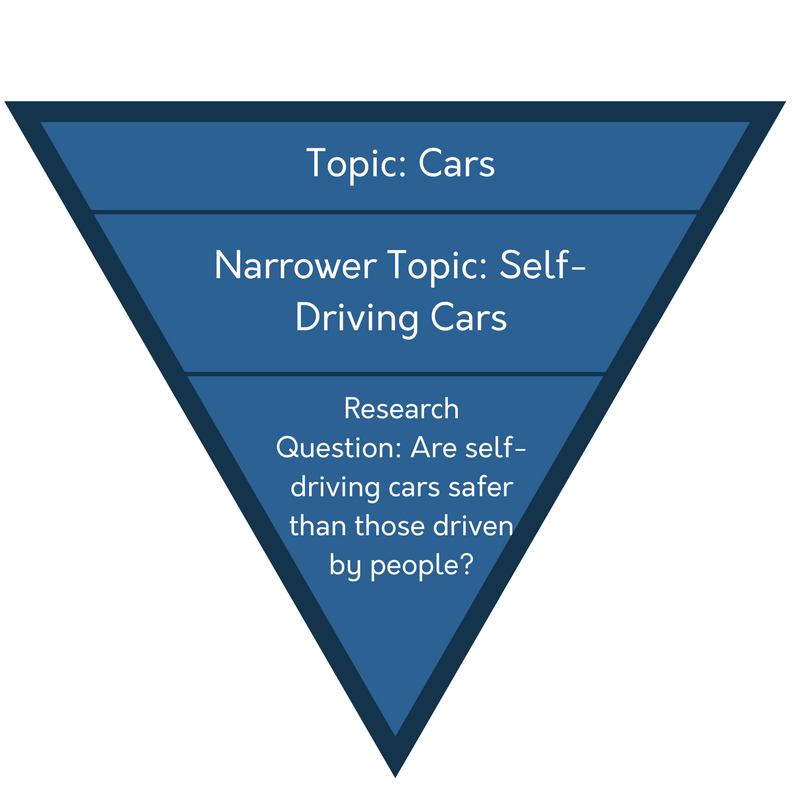
Here’s an example:
Figure 7.4 Developing a Research Question
Keywords & Search Terms
Starting with a research question helps you figure out precisely what you’re looking for. Next, you’ll need the most effective set of search terms – starting from main concepts and then identifying related terms. These keywords will become your search terms, and you’ll use them in library databases to find sources.
Identify the keywords in your research question by selecting nouns important to the meaning of your question and leaving out words that don’t help the search, such as adjectives, adverbs, prepositions and, usually, verbs. Nouns that you would use to tag your research question so you could find it later are likely to be its main concepts.
Example: How are birds affected by wind turbines?
The keywords are birds and wind turbines. Avoid terms like affect and effect as search terms, even when you’re looking for studies that report effects or effectiveness. These terms are common and contain many synonyms, so including them as search terms can limit your results.
Example: What lesson plans are available for teaching fractions?
The keywords are lesson plans and fractions. Stick to what’s necessary. For instance, don’t include: children—nothing in the research question suggests the lesson plans are for children; teaching—teaching isn’t necessary because lesson plans imply teaching; available—available is not necessary.
Keywords can improve your searching in all different kinds of databases and search engines. Try using keywords instead of entire sentences when you search Google and see how your search results improve.
For each keyword, list alternative terms, including synonyms, singular and plural forms of the words, and words that have other associations with the main concept. Sometimes synonyms, plurals, and singulars aren’t enough. Also consider associations with other words and concepts. For instance, it might help, when looking for information on the common cold, to include the term virus—because a type of virus causes the common cold.
Here’s an example of keywords & synonyms for our previous research question arranged in a graphic organizer called a Word Cloud:
Figure 7.5 What’s Your Research Question?

Once you have keywords and alternate terms, you are prepared to start searching for sources in library search engines called databases.
Exercise
Using the example shown above, create a Word Cloud for your research question. Think of at least five keywords and alternate terms you might use for searching. If your class had a library session, you will find a copy of the Word Cloud worksheet on your ENG 111 InfoGuide (http://infoguides.virginiawestern.edu/eng111) .
Managing Source Information
As you determine which sources you will rely on most, it is important to establish a system for keeping track of your sources and taking notes. There are several ways to go about it, and no one system is necessarily superior. What matters is that you keep materials in order; record bibliographical information you will need later; and take detailed, organized notes.
Keeping Track of Your Sources
Think ahead to a moment a few weeks from now, when you’ve written your
and are almost ready to submit it for a grade. There is just one task left—writing your list of sources.
As you begin typing your list, you realize you need to include the publication information for a book you cited frequently. Unfortunately, you already returned it to the library several days ago. You do not remember the URLs for some of the websites you used or the dates you accessed them—information that also must be included in your bibliography. With a sinking feeling, you realize that finding this information and preparing your bibliography will require hours of work.
This stressful scenario can be avoided. Taking time to organize source information now will ensure that you are not scrambling to find it at the last minute. Throughout your research, record bibliographical information for each source as soon as you begin using it. You may use pen-and-paper methods, such as a notebook or note cards, or maintain an electronic list. (If you prefer the latter option, many office software packages include separate programs for recording bibliographic information.)
Table 11.5 “Details for Commonly Used Source Types” shows the specific details you should record for commonly used source types. Use these details to develop a working bibliography—a preliminary list of sources that you will later use to develop the references section of your paper. You may wish to record information using the formatting system required for your project.
| Source Type | Necessary Information |
|---|---|
| Book | Author(s), title and subtitle, publisher, city of publication, year of publication |
| Essay or article published in a book | Include all the information you would for any other book. Additionally, record the essay’s or article’s title, author(s), the pages on which it appears, and the name of the book’s editor(s). |
| article published in a periodical | Author(s), article title, publication title, date of publication, volume and issue number, and page numbers |
| webpage | Author(s) (if available), article or document title, organization that sponsors the site, database name (if applicable), date of publication, date you accessed the site, and URL |
| Online video | Creator(s) as available, title of video, organization/channel that sponsors the video (as applicable), date posted, date you accessed it, URL |
| Interview | Name of person interviewed, method of communication, date of interview |
Taking Notes Efficiently
Good researchers stay focused and organized as they gather information from sources. Before you begin taking notes, take a moment to step back and think about your goal as a researcher—to find information that will help you answer your research question. When you write your paper, you will present your conclusions about the topic supported by research. That goal will determine what information you record and how you organize it.
Writers sometimes get caught up in taking extensive notes, so much so that they lose sight of how their notes relate to the questions and ideas they started out with. Remember that you do not need to write down every detail from your reading. Focus on finding and recording details that will help you answer your research questions. The following strategies will help you take notes efficiently.
Use Headings to Organize Ideas
Whether you use old-fashioned index cards or organize your notes using word-processing software, record just one major point from each source at a time, and use a heading to summarize the information covered. Keep all your notes in one file, digital or otherwise. Doing so will help you identify connections among different pieces of information. It will also help you make connections between your notes and the research questions and subtopics you identified earlier.
Know When to Summarize, Paraphrase, or Directly Quote a Source
Your notes will fall under three categories—summarynotes, paraphrased information, and direct quotationsfrom your sources. Effective researchers make choices about which type of notes is most appropriate for their purpose.
-
Summary notes sum up the main ideas in a source in a few sentences or a short paragraph. A summary is considerably shorter than the original text and captures only the major ideas. Use summary notes when you do not need to record specific details but you intend to refer to broad concepts the author discusses.
- Paraphrased notes restate a fact or idea from a source using your own words and sentence structure.
-
Direct quotations use the exact wording used by the original source and enclose the quoted material in quotation marks. It is a good strategy to copy direct quotations when an author expresses an idea in an especially lively or memorable way. However, do not rely exclusively on direct quotations in your note taking.
Most of your notes should be paraphrased from the original source. Paraphrasing as you take notes is usually a better strategy than copying direct quotations, because it forces you to think through the information in your source and understand it well enough to restate it. In short, it helps you stay engaged with the material instead of simply copying and pasting. Synthesizing will help you later when you begin planning and drafting your paper.
Maintain Complete, Accurate Notes
Regardless of the format used, any notes you take should include enough information to help you organize ideas and locate them instantly in the original text if you need to review them. Make sure your notes include the following elements:
- Heading summing up the main topic covered
- Author’s name, a source code, or an abbreviated source title
- Page number
- Full URL of any pages buried deep in a website
Throughout the process of taking notes, be scrupulous about making sure you have correctly attributed each idea to its source. Always include source information so you know exactly which ideas came from which sources. Use quotation marks to set off any words for phrases taken directly from the original text. If you add your own responses and ideas, make sure they are distinct from ideas you quoted or paraphrased.
Finally, make sure your notes accurately reflect the content of the original text. Make sure quoted material is copied verbatim. If you omit words from a quotation, use ellipses to show the omission and make sure the omission does not change the author’s meaning.
Use a System That Works for You
There are several formats you can use to take notes. No technique is necessarily better than the others—it is more important to choose a format you are comfortable using. Choosing the format that works best for you will ensure your notes are organized, complete, and accurate. Consider implementing one of these formats when you begin taking notes:
- Use index cards. This traditional format involves writing each note on a separate index card. It takes more time than copying and pasting into an electronic document, which encourages you to be selective in choosing which ideas to record. Recording notes on separate cards makes it easy to later organize your notes according to major topics. Some writers color-code their cards to make them still more organized.
- Use note-taking software. Word-processing and office software packages often include different types of note-taking software. Although you may need to set aside some time to learn the software, this method combines the speed of typing with the same degree of organization associated with handwritten note cards.
- Maintain a research notebook. Instead of using index cards or electronic note cards, you may wish to keep a notebook or electronic folder, allotting a few pages (or one file) for each of your sources. This method makes it easy to create a separate column or section of the document where you add your responses to the information you encounter in your research.
-
Annotate your sources. This method involves making handwritten notes in the margins of sources that you have printed or photocopied. If using electronic sources, you can make comments within the source document. For example, you might add comment boxes to a PDF version of an article. This method works best for experienced researchers who have already thought a great deal about the topic because it can be difficult to organize your notes later when starting your draft.
Choose one of the methods from the list to use for taking notes. Continue gathering sources and taking notes. In the next section, you will learn strategies for organizing and synthesizing the information you have found.
Key Takeaways
- Its a good idea to begin the research process with a research question.
- A writer’s use of primary and secondary sources is determined by the topic and purpose of the research. Sources used may include print sources, such as books and journals; electronic sources, such as websites and articles retrieved from databases; and human sources of information, such as interviews.
- Strategies that help writers locate sources efficiently include conducting effective keyword searches, understanding how to use online catalogs and databases, using strategies to narrow web search results, and consulting reference librarians.
- Writers evaluate sources based on how relevant they are to the research question and how reliable their content is.
- Skimming sources can help writers determine their relevance efficiently.
- Writers evaluate a source’s reliability by asking questions about the type of source (including its audience and purpose); the author’s credibility, the publication’s reputability, the source’s currency, and the overall quality of the writing, research, logic, and design in the source.
- In their notes, effective writers record organized, complete, accurate information. This includes bibliographic information about each source as well as summarized, paraphrased, or quoted information from the source.
