
Types of Sources
Katelyn Burton and Jenifer Kurtz
When you engage in research, you probably do it by opening a browser, going to a search engine, and typing in your topic. Usually, this gives you a lot of results very quickly. And, depending on the purpose of your research, what you get might be exactly what you need. But, in academic writing, you need a greater variety and more in-depth information than what you quickly get from a search engine. When you are engaging in research for a class assignment, be sure to follow your professor’s guidelines for choosing sources. He or she may have requirements for a certain number of articles, books, or websites you should include in your paper. Familiarize yourself with your professor’s requirements at the beginning, so you find the right types and amount of sources required for the project.
Using Primary and Secondary Sources
Writers classify research resources in two categories: primary sources and secondary sources. Primary sources are direct, firsthand sources of information or data. For example, if you were writing a paper about the First Amendment right to freedom of speech, the text of the First Amendment in the Bill of Rights would be a primary source.
Other primary sources include the following:
- Research articles
- Literary texts
- Historical documents such as diaries or letters
- Autobiographies or other personal accounts
- Magazine articles
- Biographical books
- Literary and scientific reviews
- Television documentaries
Your topic and purpose determine whether you must cite both primary and secondary sources in your paper. Ask yourself which sources are most likely to provide the information that will answer your research questions. If you are writing a research paper about reality television shows, you will need to use some reality shows as a primary source, but secondary sources, such as a reviewer’s critique, are also important. If you are writing about the health effects of nicotine, you will probably want to read the published results of scientific studies, but secondary sources, such as magazine articles discussing the outcome of a recent study, may also be helpful.
Once you have thought about what kinds of sources are most likely to help you answer your research questions, you may begin your search for print and electronic resources. The challenge here is to conduct your search efficiently. Writers use strategies to help them find the sources that are most relevant and reliable while steering clear of sources that will not be useful.
Finding Resources
Regardless of your topic, you will consult a variety of resources as part of your research. The Table “Research Resources” lists different types of resources available through public and university libraries. Some of these are available in both print and electronic formats, and some are available in just one or the other.
| Resource Type | Description | Example(s) |
|---|---|---|
| Reference works |
Reference works provide a summary of information about a particular topic. Almanacs, encyclopedias, atlases, medical reference books, and scientific abstracts are examples of reference works. In some cases, reference books may not be checked out of a library. Note that reference works are many steps removed from original primary sources and are often brief, so these should be used only as a starting point when you gather information. |
|
| Nonfiction books | Nonfiction books provide in-depth coverage of a topic. Trade books, biographies, and how-to guides are usually written for a general audience.
Scholarly books and scientific studies are usually written for an audience that has specialized knowledge of a topic. |
|
| Trade magazines and mainstream news sources | These sources are published at regular intervals—daily, weekly, monthly, or quarterly. Newspapers and magazines are examples. Some periodicals provide articles on subjects of general interest, while others are more specialized. |
|
| Scholarly Periodicals | These sources are also published at regular intervals — usually monthly to quarterly. They are academic journals that provide specialized information to an audience of readers who are directly and often professionally associated with the field. |
|
| Government publications | Federal, state, and local government agencies publish information on a variety of topics. Government publications include reports, legislation, court documents, public records, statistics, studies, guides, programs, and forms. |
|
| Business and nonprofit publications | Businesses and nonprofit organizations produce publications designed to market a product, provide background about the organization, provide information on topics connected to the organization, or promote a cause. These publications include reports, newsletters, advertisements, manuals, brochures, and other print documents. |
|
In addition to the resources noted in the table, library holdings may include primary texts such as historical documents, letters, and diaries.
Tip
Try to locate a mixture of different source types for your assignments. Some of your sources can be more popular, like reference works or news articles, but you should also try to find at least a few articles from journals or reputable magazines/newspapers.
Academic articles
These are also called scholarly articles, scholarly papers, journal articles, academic papers, or peer-reviewed articles. They all mean the same thing: a paper published in an academic journal after being scrutinized anonymously and judged to be sound by other experts in the subfield. Academic articles are essentially reports that scholars write to their peers—present and future—about what they’ve done in their research, what they’ve found, and why they think it’s important. Scholarly journals and books from academic presses use a peer-review process to decide which articles merit publication. The whole process, outlined below, can easily take a year or more!
Figure 6.1 Understanding the Academic Peer Review Process
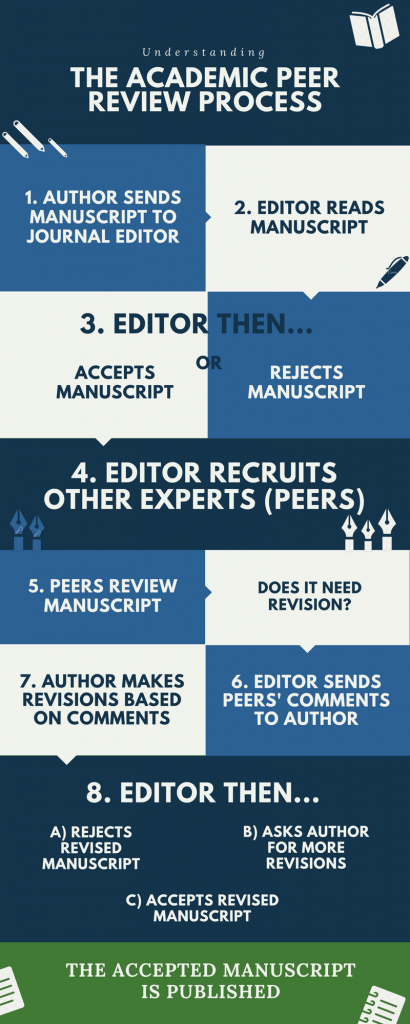
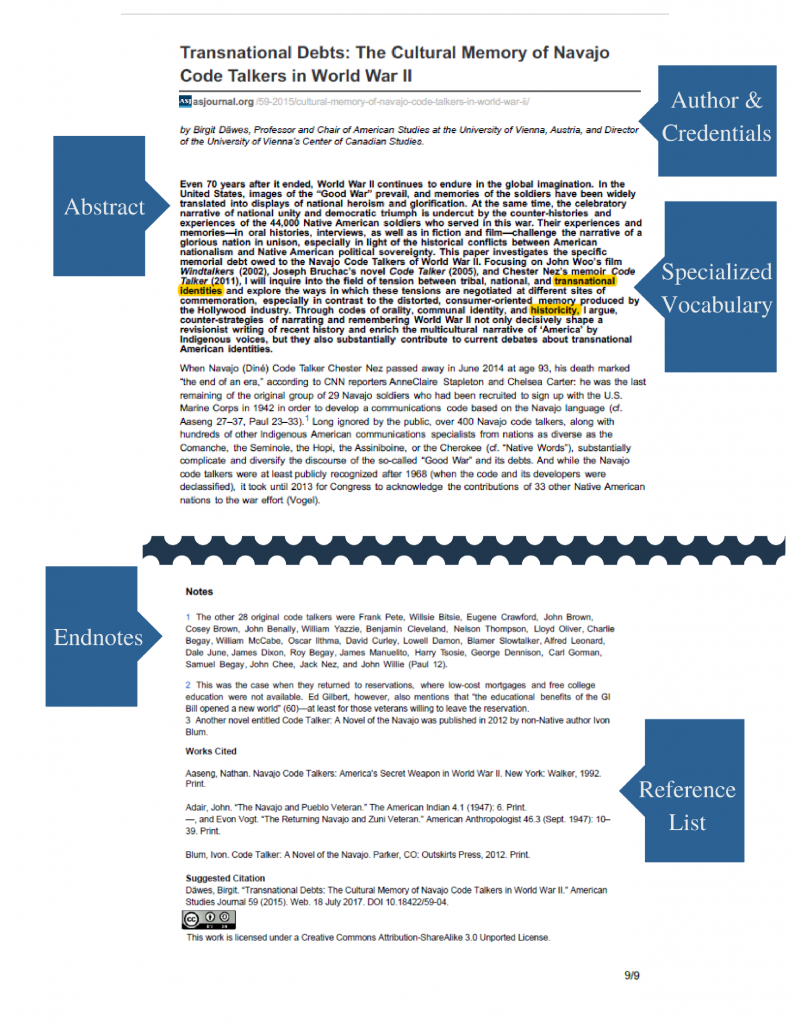
When you are trying to determine if a source is scholarly, look for the following characteristics:
- Structure: The full text article often begins with an abstract or summary containing the main points of the article. It may also be broken down into sections like “Methods,” “Results,” and “Discussion.”
- Authors: Authors’ names are listed with credentials/degrees and places of employment, which are often universities or research institutions. The authors are experts in the field.
- Audience: The article uses advanced vocabulary or specialized language intended for other scholars in the field, not for the average reader.
- Length: Scholarly articles are often, but not always, longer than the popular articles found in general interest magazines like Time, Newsweek, National Geographic, etc. Articles are longer because it takes more content to explore topics in depth.
- Bibliography or Reference List: Scholarly articles include footnotes, endnotes or parenthetical in-text notes referring to items in a bibliography or reference list. Bibliographies are important to find the original source of an idea or quotation.
Figure 6.2 Example Scholarly Source
Reading Popular and Scholarly Periodicals
When you search for periodicals, be sure to distinguish among different types. Mass-market publications, such as newspapers and popular magazines, differ from scholarly publications in their accessibility, audience, and purpose.
Newspapers and magazines are written for a broader audience than scholarly journals. Their content is usually quite accessible and easy to read. Trade magazines that target readers within a particular industry may presume the reader has background knowledge, but these publications are still reader-friendly for a broader audience. Their purpose is to inform and, often, to entertain or persuade readers as well.
Because of these differences, scholarly journals are more challenging to read. That doesn’t mean you should avoid them. On the contrary, they can provide in-depth information unavailable elsewhere. Because knowledgeable professionals carefully review the content before publication, scholarly journals are far more reliable than much of the information available in popular media. Seek out academic journals along with other resources. Just be prepared to spend a little more time processing the information.
Consulting a Reference Librarian
Sifting through library stacks and database search results to find the information you need can be like trying to find a needle in a haystack. If you are not sure how you should begin your search, or if it is yielding too many or too few results, you are not alone. Many students find this process challenging, although it does get easier with experience. One way to learn better search strategies is to consult a reference librarian.
Reference librarians are intimately familiar with the systems libraries use to organize and classify information. They can help you locate a particular book in the library stacks, steer you toward useful reference works, and provide tips on how to use databases and other electronic research tools. Take the time to see what resources you can find on your own, but if you encounter difficulties, ask for help. Many university librarians hold virtual office hours and are available for online chatting.
Finding and Using Electronic Resources
With the expansion of technology and media over the past few decades, a wealth of information is available to you in electronic format. Some types of resources, such as a television documentary, may only be available electronically. Other resources—for instance, many newspapers and magazines—may be available in both print and electronic form. The following are some of the electronic sources you might consult:
- Online databases
- CD-ROMs
- Popular web search engines
- Websites maintained by businesses, universities, nonprofit organizations, or government agencies
- Newspapers, magazines, and journals published on the web
- E-books
- Audio books
- Industry blogs
- Radio and television programs and other audio and video recordings
- Online discussion groups
The techniques you use to locate print resources can also help you find electronic resources efficiently. Libraries usually include CD-ROMs, audio books, and audio and video recordings among their holdings. You can locate these materials in the catalog using a keyword search. The same Boolean operators used to refine database searches can help you filter your results in popular search engines.
Using Internet Search Engines Efficiently
When faced with the challenge of writing a research paper, some students rely on popular search engines as their first source of information. Typing a keyword or phrase into a search engine instantly pulls up links to dozens, hundreds, or even thousands of related websites—what could be easier? Unfortunately, despite its apparent convenience, this research strategy has the following drawbacks to consider:
- Results do not always appear in order of reliability. The first few hits that appear in search results may include sites whose content is not always reliable, such as online encyclopedias that can be edited by any user. Because websites are created by third parties, the search engine cannot tell you which sites have accurate information.
- Results may be too numerous for you to use. The amount of information available on the web is far greater than the amount of information housed within a particular library or database. Realistically, if your web search pulls up thousands of hits, you will not be able to visit every site—and the most useful sites may be buried deep within your search results.
- Search engines are not connected to the results of the search. Search engines find websites that people visit often and list the results in order of popularity. The search engine, then, is not connected to any of the results. When you cite a source found through a search engine, you do not need to cite the search engine. Only cite the source.
A general web search can provide a helpful overview of a topic and may pull up genuinely useful resources. To get the most out of a search engine, however, use strategies to make your search more efficient. Use multiple keywords and Boolean operators to limit your results. Click on the Advanced Search link on the homepage to find additional options for streamlining your search. Depending on the specific search engine you use, the following options may be available:
- Limit results to websites that have been updated within a particular time frame.
- Limit results by language or country.
- Limit results to scholarly works available online.
- Limit results by file type.
- Limit results to a particular domain type, such as .edu (school and university sites) or .gov (government sites). This is a quick way to filter out commercial sites, which can often lead to more objective results.
Use the Bookmarks or Favorites feature of your web browser to save and organize sites that look promising.
Using Other Information Sources: Interviews
With so many print and electronic media readily available, it is easy to overlook another valuable information resource: other people. Consider whether you could use a person or group as a primary source. For instance, you might interview a professor who has expertise in a particular subject, a worker within a particular industry, or a representative from a political organization. Interviews can be a great way to get firsthand information.
To get the most out of an interview, you will need to plan ahead. Contact your subject early in the research process and explain your purpose for requesting an interview. Prepare detailed questions. Open-ended questions, rather than questions with simple yes-or-no answers, are more likely to lead to an in-depth discussion. Schedule a time to meet, and be sure to obtain your subject’s permission to record the interview. Take careful notes and be ready to ask follow-up questions based on what you learn.
Key Takeaways
- There are several different categories of academic and popular sources. Scholarly sources are usually required in academic papers.
- It’s important to understand your professor’s requirements and look for sources that fill those requirements.
- Try to find a variety of different source types to help you fully understand your topic.
