
Guide to Written Communication
Why Communication Matters
Communication is at the heart of the professional world. Short emails, complex reports, private chats and formal presentations circulate information and ideas and drive decisions.
Professional communication typically has one or more of the following purposes; click each purpose in the interactive list below to learn more:
Regardless of your specific purpose, powerful communication matters:
- Clear and concise writing gets noticed and leads to action.
- Demonstrated communication skills improve your job prospects.
- Powerful communication enables you to inspire and guide others.
Formal education and on-the-job training help you deepen your technical knowledge in your chosen field. However, if you do not learn to effectively pitch a new idea to your team, persuade a stakeholder, or clarify data for a client, your influence will be blunted.
Employers are eager to hire good writers because clear writing demonstrates clear thinking. Hone your written communication skills to contribute solutions to your workplace and enhance your own career.
Business Writing
Plain language is a term used to describe clear, concise writing. Figures 19.1 and 19.2 illustrate plain language with before-and-after examples.[1]
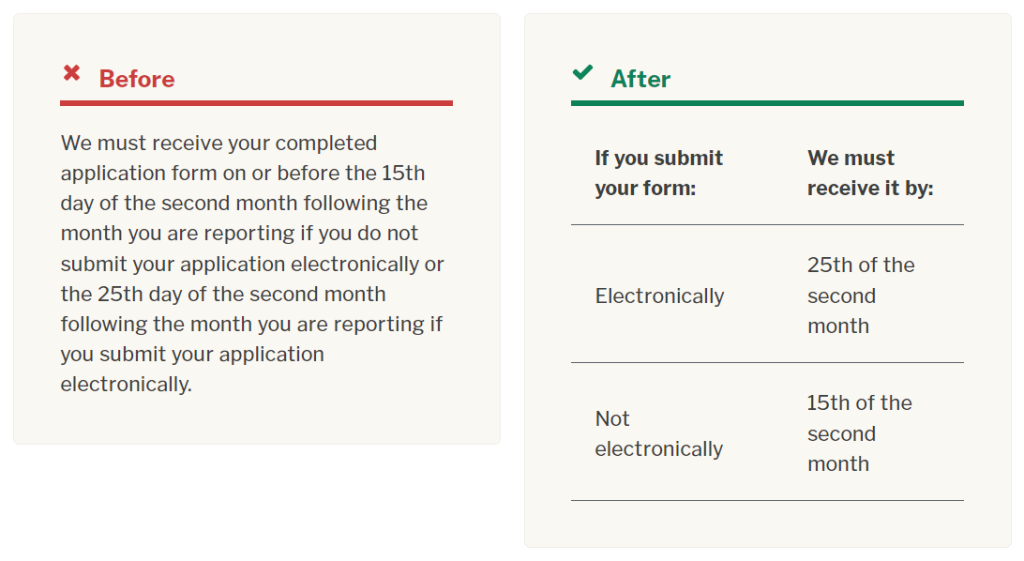
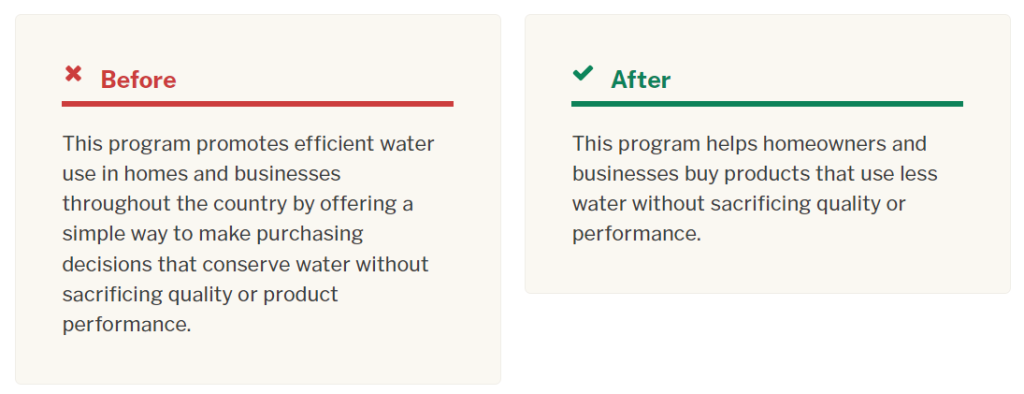
The sections that follow highlight key guidelines[2] for writing with plain language, including:
- Consider your audience
- Be concise
- Choose your language carefully
- Organize your writing
1. Consider Your Audience
Your audience determines your communication style. When writing, keep the following in mind:
- A busy audience wants concise, no-nonsense information.
- An analytical audience wants solid evidence and transparency.
- A diverse audience needs language that does not create misunderstandings or confusion.
- A decisive audience wants well-reasoned recommendations.
- A decision-maker audience wants only pertinent, reliable, accessible information.
Use language your audience understands and feels comfortable with. Take your audience’s current level of knowledge into account. Then, guide them through the information they need to know. To help you do this, try answering the following questions:
- Who is my audience?
- What does my audience already know about the subject?
- What does my audience need to know?
- What questions will my audience have?
- What’s the best outcome for those involved? What do I need to say to get this outcome?
2. Be Concise
Wordy, dense construction is one of the biggest problems in business writing. Nothing is more confusing to the user than long, complex sentences containing multiple phrases and clauses. Unnecessary words come in all shapes and sizes. To address this problem, become more critical of your own writing, and consider whether you need every word.
Unnecessary words waste your audience’s time. Great writing is like a conversation. Omit information that the audience doesn’t need to know. This can be difficult if you are subject matter expert, so it’s important to have someone look at the information from the audience’s perspective.
Write Concise Sentences
Express only one idea in each sentence. Long, complicated sentences often mean that you aren’t sure about what you want to say. Shorter sentences are also better for conveying complex information; they break the information up into smaller, easier-to-process units.
Write Concise Paragraphs
Write short paragraphs and cover one topic per paragraph. Short paragraphs are easier to read and understand. Writing experts recommend paragraphs of three to eight sentences. Vary the lengths of your paragraphs to make your writing more interesting.
Write Concise Sections
Short sections break up material so it appears easier to comprehend. Long, dense sections with no white space are visually unappealing, and give the impression your writing is difficult to understand. Short sections also help you organize your thoughts more effectively.
Short sections give you the opportunity to add useful headings, which help the reader skim and scan the page. Long sections are impossible to summarize meaningfully in a heading. When you break up different concepts into short sections, each heading can give the reader a clear picture of what’s in that section.
3. Choose Your Words Carefully
Words matter. They are the most basic building blocks of written and spoken communication. Don’t complicate things by using jargon, technical terms, or abbreviations that people won’t understand. Choose your words carefully and be consistent in your writing style.
Use Clear Language
When you’re making word choices, pick the familiar or commonly used word over the unusual or obscure.
Special terms can be useful shorthand within a particular audience and may be the clearest way to communicate with that group. However, going beyond necessary technical terms to write in jargon can cause misunderstanding or alienation, even if your only readers are specialists.
Readers complain about jargon more than any other writing fault, because writers often fail to realize that terms they know well may be difficult or meaningless to their audience. Try to substitute everyday language for jargon as often as possible.
When you have no way to express an idea except to use technical language, make sure to define your terms. However, it’s best to keep definitions to a minimum. Remember to write to communicate, not to impress.
Use Active Voice
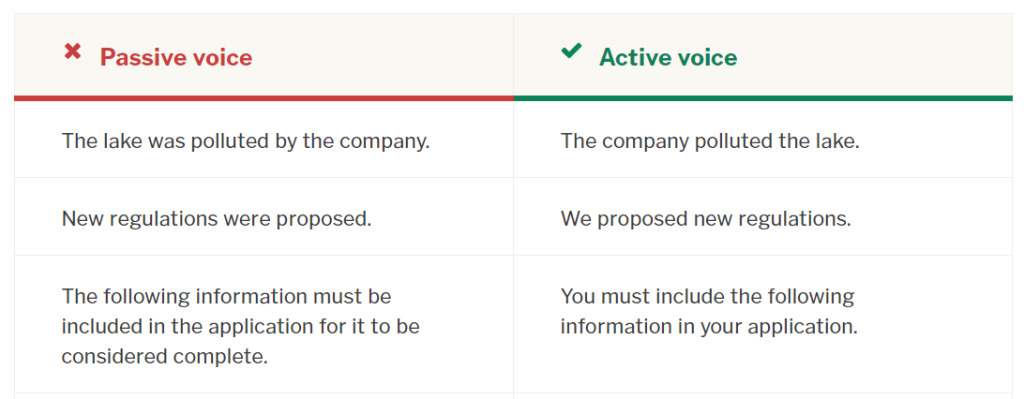
Active voice makes it clear who is supposed to do what. Passive voice obscures who is responsible for what and is one of the biggest problems with business writing. Don’t confuse passive voice with past tense.
In an active sentence, the person or entity that is acting is the subject of the sentence. In a passive sentence, the person or item that is acted upon is the subject of the sentence. Passive sentences often do not identify who is performing the action (Figure 19.3).
Use Examples
Examples help you clarify complex concepts. When you ask for clarification of something, people often respond by giving you an example. Good examples can substitute for long explanations. The more complex the concept you are writing about, the more you should consider using an example. By giving your audience an example that’s relevant to their situation, you help them relate to your writing.
4. Organize Your Writing
Organize your writing so it’s easy to follow along. To do so:
Arrange Content in a Logical Order
In some situations, presenting information chronologically may work best. In other situations, you may want to put general information first, and specialized information or exceptions later. That way, the material that addresses most readers in most situations comes first.
Use Headings
Logically-ordered writing will still be difficult for users to follow if they can’t see how it’s organized. An effective way to reveal your document’s organization is to use lots of useful headings.
It’s often useful to start writing your document by developing the headings, structuring them to your audience’s concerns. This approach can also reveal major groupings of information that you might want to identify with headings.
Use Topic Sentences
Establish a context for your audience before you provide them with the details. If you flood readers with details first, they become impatient and may resist hearing your message. A good topic sentence draws the reader in.
Use Lists
Use lists to help your user focus on important material in a visually clear way.
Lists are useful because they:
- Highlight levels of importance
- Help the reader understand the order in which things happen
- Help readers skim and scan
- Make it easy to identify all steps in a process
- Add white space for easy reading
You can overuse lists. Remember to use them to highlight important information, not to overemphasize trivial matters.
Highlight Important Information
You can also add bold and italics to emphasize important concepts within a particular section. Only emphasize important information, and do so sparingly, otherwise you’ll dilute its impact.
PUTTING EVERYTHING IN CAPITAL LETTERS IS NOT A GOOD EMPHASIS TECHNIQUE. ALTHOUGH IT MAY DRAW THE USER’S ATTENTION TO THE SECTION, IT MAKES IT HARDER TO READ. AND ONLINE, IT’S CONSIDERED SHOUTING.
Similarly, underlining will draw the user’s attention to the section, but it makes it hard to read.
Besides, when reading online, people expect underlined text to be a link. It’s better to use bold and italics for important issues.
Business Writing, In Summary
Watch Video 19.1: Business Writing Tips to review ways to write effectively for professional audiences. Closed captioning is available. Click HERE to read a transcript.
Watch Video 19.2: Formatting a Business Document to review ways to create effective documents for professional audiences. Closed captioning is available. Click HERE to read a transcript.
Professional Email
In the workplace, email remains a dominant form of collaborative communication between individuals and among teams, and (especially) with external audiences like suppliers and customers. For now, being a savvy emailer continues to be an important aspect of achieving career success.
Email Strategy and Etiquette
Writing effective emails involves many of the guidelines for plain language described in the first part of this chapter. Thinking specifically about email, keep the following strategies in mind:
- Keep your email messages short and direct. Rarely should an email message exceed one screen. If the reader has to scroll, your message is likely too long.
- Formally open and close your email messages.
- Put thought into your subject line. Craft a line that grabs attention and provides substantive information. Your recipient likely receives many emails per day. Write a subject line that stands out! If you need a response, say so in the subject line. For example, “Response needed: Dates for our next meeting.”
- Because emails are more formal than texting, adopt a tone that is friendly but not gushy. Limit the use of exclamation points; one per email is generally an appropriate limit.
The following examples illustrate plain language guidelines applied to email.
Use Paragraphs
Suppose you’re emailing a potential business partner. This is an external message—perfect for email.
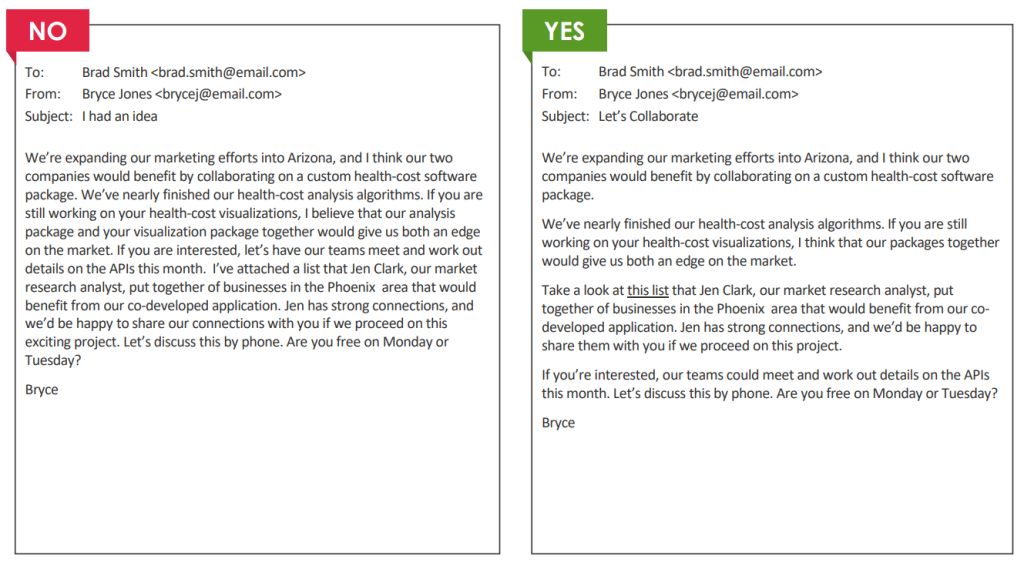
The first example below is an uninviting wall of text (Figure 19.4). The second example uses paragraphs to divide the meaning into sections and make the email more visually appealing. Which would you rather read?
Use Visual Signposts and Topics Sentences
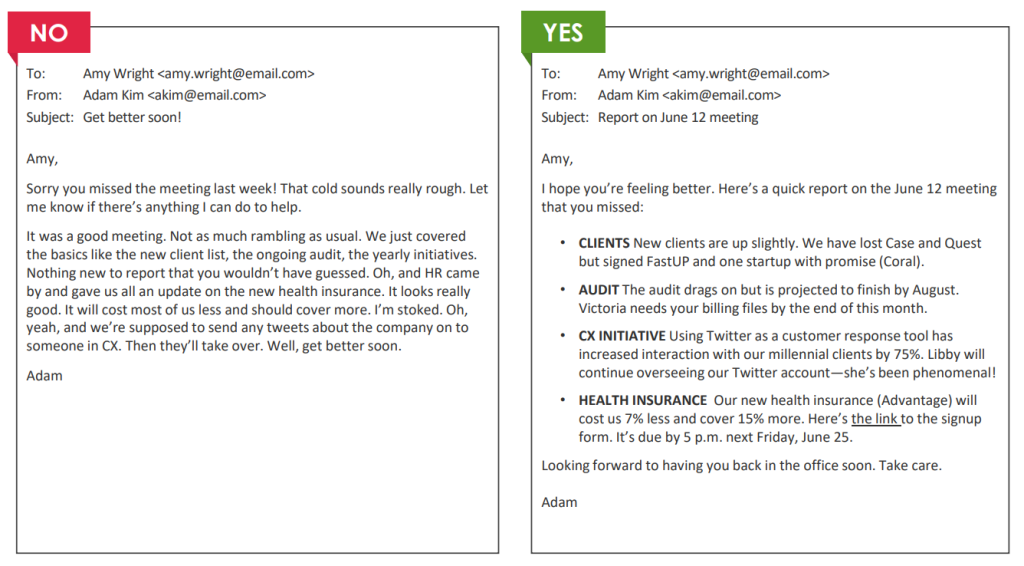
Visual signposts catch the reader’s eye. Bold text, bullet lists, and indents all highlight your important points. Topic sentences help readers get your message even if they skim your email.
Below are two versions of an email to a colleague in another department of the same company—again, an appropriate use of email (Figure 19.5). Note the rambling structure and chatty tone of the “NO” example vs. the clarity and professionalism of the “YES” example.
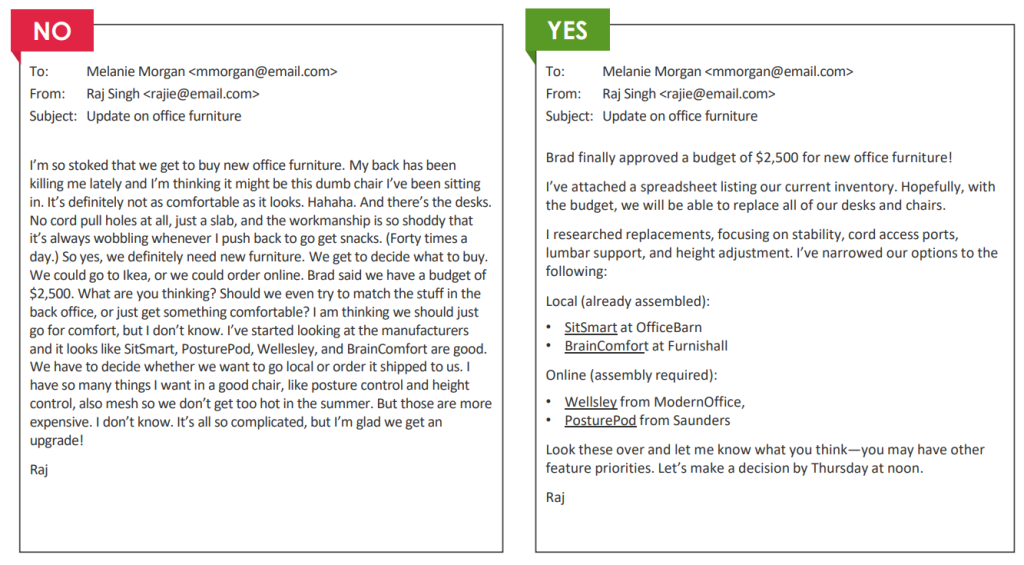
In this example, a manager in the finance organization is emailing someone in the supply chain organization regarding the need for new office furniture (Figure 19.6).
Professional Email, In Summary
Watch Video 19.3: Writing an Effective Business Email for a summary of how to compose professional email messages. Closed captioning is available. Click HERE to read a transcript.
Optional Resources to Learn More
 |
Articles |
| “Why You Can’t Abandon the Written Word, Even in a Tech-Driven World” https://www.inc.com/john-hall/why-you-cant-abandon-written-word-even-in-a-tech-driven-world.html | |
 |
Books |
| Management Communication (free textbook) https://mcom320.net/index.html | |
| A Plain English Handbook (free handbook from the SEC) https://www.sec.gov/pdf/handbook.pdf | |
| Writing on the Job: Best Practices for Communicating in the Digital Age by Martha B. Coven | |
| They Say I Say by Gerald Graff and Cathy Birkenstein | |
| On Writing Well by William Zinsser | |
| Style: Lessons in Clarity and Grace by Joseph M. Williams and Joseph Bizup | |
 |
Videos |
| “3 Ways To Make Your Writing Clearer” https://youtu.be/prUqCd2R3Zw | |
| “Plain Language for Everyone, Even Experts” https://youtu.be/bAvW1A7UiYM | |
 |
Websites |
| Plain Language https://www.plainlanguage.gov/ | |
| Purdue Owl – Email Etiquette https://owl.purdue.edu/owl/general_writing/academic_writing/email_etiquette.html |
Chapter Attribution
This chapter incorporates material from the following sources:
Thomas, L. (2020). Management communication. https://mcom320.net/pdf/fulltextbook.pdf. Licensed with CC BY-SA 4.0.
Plainlanguage.gov (n.d.). Plain language guidelines. https://www.plainlanguage.gov/guidelines/. This content is in the public domain.
Media Attributions
Figures 19.1, 19.2, and 19.3: Plainlanguage.gov (n.d.). Plain language guidelines. https://www.plainlanguage.gov/guidelines/. This content is in the public domain.
Figures 19.4, 19.5, and 19.6: Thomas, L. (2020). Management communication. https://mcom320.net/pdf/fulltextbook.pdf. Licensed with CC BY-SA 4.0.
Video 19.1: GCFLearnFree. (2017, November 22). Business writing tips [Video]. YouTube. https://youtu.be/LrKesGslOYs
Video 19.2: GCFLearnFree. (2018, May 14). Formatting a business document [Video]. YouTube. https://youtu.be/vO2Mbyu4NSM
Video 19.3: GCFLearnFree. (2017, December 6). Writing an effective business email [Video]. YouTube. https://youtu.be/amJZXjxnhTI
- https://www.plainlanguage.gov/examples/before-and-after/ ↵
- These guidelines are adapted from plainlanguage.gov, where you can find more comprehensive and detailed recommendations to improve your written communication. ↵
What is Negotiation?
Negotiation is the process by which individuals or groups attempt to realize their goals by bargaining with another party who has at least some control over goal attainment. We often step in and negotiate when a conflict is taking place, but conflict doesn’t have to exist for there to be an opportunity for negotiation.
Imagine buying a car and discussing the price with the car dealership. Or picture yourself at a job interview, discussing the terms of your employment. Both are examples of negotiations, and both scenarios involve finding a solution that works for both parties. The dealership wants to sell the car and you would like to buy it; similarly, the organization would like to hire you and you are interested in working for them. Reaching an agreement would benefit both parties in each of these scenarios.
Negotiation Skills
Effective negotiation involves various skills: listening, communication, emotional intelligence, influence, problem solving, and decision-making. Click on each of these skills in the interactive list below to learn how each contributes to effective negotiation.
Skills that Contribute to Effective Negotiation
While various skills contribute to effective negotiation, as described above, navigating the negotiation process is its own skillset. The remainder of this chapter will focus on helping you understand the negotiation process and different approaches to negotiation so you can begin to develop your negotiation skills.
The Negotiation Process
The negotiation process consists of identifying your desired goals—that is, what you are trying to get out of the exchange—and then developing suitable strategies aimed at reaching those goals. A key feature of your strategy is knowing your relative position in the bargaining process. In other words, depending upon your relative position or strength, you may want to negotiate seriously, or you may want to tell your opponent to “take it or leave it.” For example, you may wish to negotiate when you value the exchange, when you value the relationship, and when commitment to the issue is high. In an opposite situation, you may be indifferent to serious bargaining.
The negotiation process can be summarized in four key steps, described in greater detail in the sections that follow:
- Planning and preparing
- Presenting and clarifying
- Bargaining and problem solving
- Closing and reflecting
Step 1: Planning and Preparing
The first stage of a negotiation, planning and preparing (Video 1), begins with self-discovery: What do you want and/or need from this negotiation? What are your goals? What is important to you, and what will you give up? You need to remember that at this stage, you likely have the clearest view of your goals since the negotiation process has not formally begun yet.
You also want to take this time to consider the other party so you can have an idea of where this process might take you. What are their goals in this negotiation? What will they ask for? What might they settle for, and how does that differ from the outcome you are hoping for?
Video 1: How to Prepare for a Negotiation. Closed captioning is available.
https://youtu.be/NeWWU6nTvEA
BATNA
Also during the planning and preparing phase, you explore your BATNA, or your “best alternative to a negotiated agreement.”[1] Why do you need to think about alternatives when you are in a negotiation? The simple answer is to figure out whether negotiation is even worth it. Do you want to go through the negotiation process if you have other options that will make you just as satisfied, if not more?
When you have more options, you are likely to evaluate negotiation proposals with a more critical eye and get the best deal possible for yourself. Having a BATNA makes you really think about how a proposal fares in relation to your alternatives. Is it better? Is it worse? This comparison will allow you to critically evaluate whether you should take a deal or walk away from it entirely.
The party with the best BATNA has the best negotiating position, so try to improve your BATNA whenever possible by exploring possible alternatives (Pinkley, 1995).
Step 2: Presenting and Clarifying
In the second stage of a negotiation, you present your proposals and listen to counter-proposals. Both parties will explain, clarify, bolster and justify their respective positions or demands. For you, this is an opportunity to educate the other side on your position, as well as to gain further understanding about the other party and how they feel about their position. You might each take the opportunity to explain how you arrived at your current position, and include any supporting documentation.
This doesn’t need to be—and should not be—confrontational, though in some negotiations, that’s hard to avoid. But if tempers are high moving into this portion of the negotiation process, then those emotions will start to come to a head here. It’s important for you to manage those emotions so serious bargaining can begin.
Step 3: Bargaining and Problem Solving
The bargaining and problem solving phase of a negotiation involves mutual adjustment. When you presented your proposals, you likely discovered areas of disagreement or potential conflicts, and now you need to come up with solutions that both parties will agree to. Both parties have an idea of what they want the final outcome to look like, but you need to now work together to create something that will be satisfying to both parties.
A natural part of this process is making concessions, namely, giving up one thing to get something else in return. Making a concession is not a sign of weakness—parties expect to give up some of their goals. Instead, concessions demonstrate cooperativeness and help move the negotiation toward closure. Making a concession shows forward movement and process, and it allays concerns about rigidity or closed-mindedness.
This is where the planning and preparing step becomes even more important. You should enter a negotiation knowing that you will likely have to make concessions at some point, so you need to have a clear understanding of what is important to you. What are you willing to give up so that you can gain something else? This is where communication and active listening become so vital to effective negotiations. You need to truly understand why the other party wants something or is unwilling to give something up. You need to understand where their constraints stem from rather than just accepting their constraints at face value. The more you understand the “why” behind their positioning, the better equipped you are to create solutions that will be mutually beneficial.
Let’s take a look at an example. Say that you’re a retailer and you want to buy patio furniture from a manufacturer. You want to have the sets in time for spring sales. During the negotiations, your goal is to get the lowest price with the earliest delivery date. The manufacturer, of course, wants to get the highest price with the longest lead time before delivery. As negotiations stall, you evaluate your options to decide what’s more important: a slightly lower price or a slightly longer delivery date? You do a quick calculation. The manufacturer has offered to deliver the products by April 30, but you know that some of your customers make their patio furniture selection early in the spring, and missing those early sales could cost you $1 million. So, you suggest that you can accept the April 30 delivery date if the manufacturer will agree to drop the price by $1 million.
“I appreciate the offer,” the manufacturer replies, “but I can’t accommodate such a large price cut.” Instead of leaving it at that, you ask, “I’m surprised that a 2-month delivery would be so costly to you. Tell me more about your manufacturing process so that I can understand why you can’t manufacture the products in that time frame.”
“Manufacturing the products in that time frame is not the problem,” the manufacturer replies, “but getting them shipped from Asia is what’s expensive for us.”
When you hear that, a light bulb goes off. You know that your firm has favorable contracts with shipping companies because of the high volume of business the firm gives them. You make the following counteroffer: “Why don’t we agree that my company will arrange and pay for the shipper, and you agree to have the products ready to ship on March 30 for $10.5 million instead of $11 million?” The manufacturer accepts the offer—the biggest expense and constraint (the shipping) has been lifted. You, in turn, have saved money as well (Malhotra & Bazerman, 2007).
Step 4: Closing and Reflecting
The final stage of a negotiation is closing and reflecting. This is the point in a negotiation where everything comes together, and the negotiation ideally comes to a successful close. However, you may experience negotiations in which the execution phase is simply the end of the discussion, and one or more of the parties choose to walk away.
Most negotiators assume that if their best offer has been rejected, there’s nothing left to do. You made your best offer and that’s the best you can do. The savviest of negotiators, however, see the rejection as an opportunity to learn. “What would it have taken for us to reach an agreement?” By following up in this manner, you might learn something that’s useful for future negotiations. What’s more, the other party may be more willing to disclose the information if they don’t think you’re in a "deal-making" mode.
Negotiation Approaches
Negotiations can be categorized into two main types: distributive bargaining and integrative bargaining.
Distributive Bargaining
In essence, distributive bargaining is “win-lose” bargaining (Video #). That is, the goals of one party are in fundamental and direct conflict with those of the other party. Resources are fixed and limited, and each party wants to maximize her share of these resources. Finally, in most cases, this situation represents a short-term relationship between the two parties. In fact, such parties may not see each other ever again.
Video #: LINGO: Distributive Negotiation. Closed captioning is available.
https://youtu.be/5fmY3JV6iNI
A good example of this can be seen in the relationship between the buyer and seller of a house. If the buyer gets the house for less money (that is, she “wins”), the seller also gets less (that is, she “loses”).
| Two Approaches to Bargaining | ||
|---|---|---|
| Bargaining Characteristic | Distributive Bargaining | Integrative Bargaining |
| Payoff structure | Fixed amount of resources to be divided | Variable amount of resources to be divided |
| Primary motivation | I win, you lose | Mutual benefit |
| Primary interests | Opposed to each other | Convergent with each other |
| Focus of relationships | Short term | Long term |
Integrative Bargaining
Integrative bargaining is often described as a “win-win” approach (Video #). That is, with this technique, both parties try to reach a settlement that benefits both parties. Such an approach is often predicated on the belief that if people mutually try to solve the problem, they can identify some creative solutions that help everyone. A good example can be seen in bilateral trade negotiations between two nations. In such negotiations, participants usually agree that a trade war would hurt both sides; therefore, both sides attempt to achieve a balance of outcomes that are preferable to a trade war for both sides. In doing so, however, the trick is to give away as little as possible to achieve the balance.[2]
Video #: LINGO: Integrative Negotiation. Closed captioning is available.
https://youtu.be/rJEOylZCUUs
As shown previously in Table 1, the integrative approach is characterized by the existence of variable resources to be divided, efforts to maximize joint outcomes, and the desire to establish or maintain a long-term relationship. The interests of the two parties may be convergent (noncompetitive, such as preventing a trade war between two countries) or congruent (mutually supportive, as when two countries reach a mutual defense pact).
Integrative bargaining tactics are quite different from those typically found in distributive bargaining. Here, both sides must be able and willing to understand the viewpoints of the other party. Otherwise, they will not know where possible consensus lies. Moreover, the free flow of information is required. Obviously, some degree of trust is required here too. In discussions, emphasis is placed on identifying communalities between the two parties; the differences are played down. And, finally, the search for a solution focuses on selecting those courses of action that meet the goals and objectives of both sides. This approach requires considerably more time and energy than distributive bargaining, yet, under certain circumstances, it has the potential to lead to far more creative and long-lasting solutions.
Common Mistakes in Negotiations
Chapter Attribution
Source: https://open.lib.umn.edu/organizationalbehavior/chapter/10-5-negotiations/
Source: https://openstax.org/books/organizational-behavior/pages/14-4-negotiation-behavior
Source: https://ecampusontario.pressbooks.pub/effectivenegotiations/
Media Attributions
Table 1: Copyright Rice University, OpenStax, under CC BY-NC-SA 4.0 license
Exhibit 14.6 Distributive Bargaining in Buying a Home (Attribution: Copyright Rice University, OpenStax, under CC BY-NC-SA 4.0 license)
Video 1: Chicago Booth Review. (2019, March 12). How to prepare for a negotiation [Video]. YouTube. https://youtu.be/NeWWU6nTvEA
